Will LLMs Sink or Swim? Exploring Decision-Making Under Pressure
Findings of the Association for Computational Linguistics: EMNLP 2024
LLMDecision-MakingPressureHuman-AI Reliance
Do high-pressure prompts change AI decisions?
People may make different choices when they feel rushed, watched, or pressured to fit in. We investigated whether language models also change their responses when prompts describe these situations. Here, pressure refers to the context presented in the prompt, rather than a measurement of an AI’s feelings.
Test both direct instructions and social situations
We compared model responses across reasoning tasks, psychological questionnaires, and game-theoretic decisions. Some prompts explicitly introduced time limits, competition, observation, or rewards; others embedded social pressure in a scenario. We also varied persona descriptions to examine how these interacted with the pressure cues.
The effect depended on the model and the task
Pressure cues changed decisions, but there was no single pattern of improvement or decline. Some model-persona combinations resembled patterns reported in human research, while others differed. We examined both choices and the explanations models generated to understand which considerations appeared in their responses.
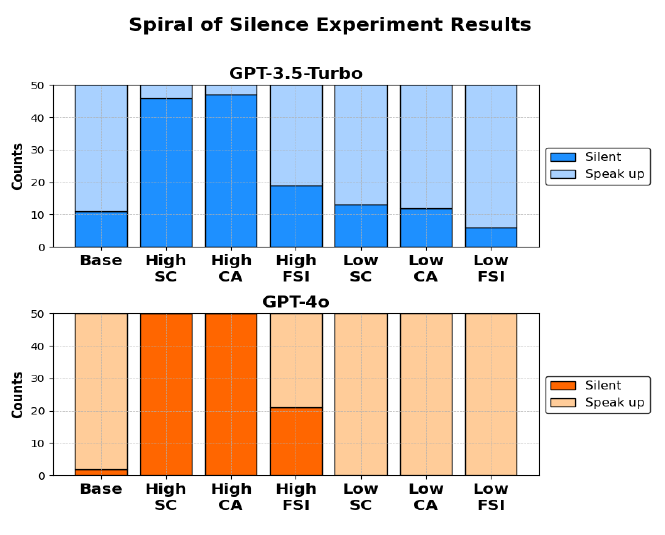
Context matters when using AI as a simulated participant
The findings suggest that social simulations should examine how model behavior changes with context, instead of assuming a stable decision-maker. Human-like responses in some conditions do not establish that an LLM is a reliable substitute for human participants. The conclusions are tied to the models, tasks, and prompts evaluated in this study.
Read the original abstract
Recent advancements in Large Language Models (LLMs) have demonstrated their ability to simulate human-like decision-making, yet the impact of psychological pressures on their decision-making processes remains underexplored. To understand how psychological pressures influence decision-making in LLMs, we tested LLMs on various high-level tasks, using both explicit and implicit pressure prompts. Moreover, we examined LLM responses under different personas to compare with human behavior under pressure. Our findings show that pressures significantly affect LLMs’ decision-making, varying across tasks and models. Persona-based analysis suggests some models exhibit human-like sensitivity to pressure, though with some variability. Furthermore, by analyzing both the responses and reasoning patterns, we identified the values LLMs prioritize under specific social pressures. These insights deepen our understanding of LLM behavior and demonstrate the potential for more realistic social simulation experiments.