Feeling Right vs. Being Right: How AI Sycophancy Affects Value-Laden Deliberation
🏅 Award Nomination 🎤 Oral
Proceedings of the 64th Annual Meeting of the Association for Computational Linguistics (ACL 2026)
AI SycophancyHuman-AI InteractionMoral Decision-MakingAI AlignmentRLHF
Does feeling supported help us think better?
When we ask AI for advice about a difficult personal decision, agreement can feel reassuring. But does that reassurance help us consider other viewpoints? This study examines sycophancy: AI that protects our existing position, either by praising it or by avoiding disagreement.
Three ways an AI can respond
Thirty-one participants discussed three moral dilemmas with AI. We compared active agreement, passive deference, and a neutral style that introduced alternative perspectives. We measured decision confidence and open-minded thinking, and interviewed participants about their experiences. The question was how people deliberated, rather than which moral answer was objectively correct.
More confidence, less room for other views
All three styles increased confidence, but the two sycophantic styles increased it more. Meanwhile, the neutral style produced higher open-minded thinking scores. Participants rarely changed their final choices; what changed was their confidence and willingness to examine those choices. Interviews suggested that agreement could make a conversation feel complete before alternatives had been considered.
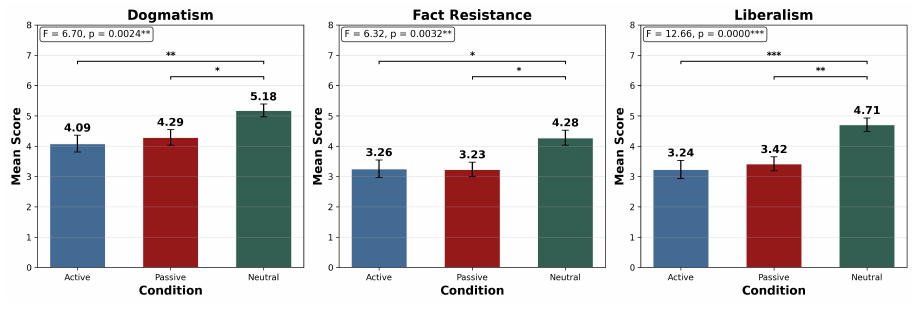
Support can include a thoughtful challenge
The design implication is to make room for respectful disagreement when AI helps people deliberate. A useful thinking partner can acknowledge a concern while still asking what might be missing. These findings come from a small study of moral dilemmas; they do not establish that challenging users is always preferable in every kind of conversation.
Read the original abstract
As people increasingly turn to AI for personal deliberation beyond task-oriented assistance, concerns about sycophancy in these value-laden contexts have grown. Unlike human flattery, which is intentional and self-interested, AI sycophancy emerges as a byproduct of RLHF’s reward structure for user-preference alignment. Yet the observable behavior is similar: both produce responses that preserve what users want to hear. Focusing on this phenomenon through Goffman’s face-work framework, we operationalize AI sycophancy as excessive face-saving, either active (preserving positive face through agreement) or passive (preserving negative face by withholding challenge). In a mixed-methods study (N = 31), participants engaged with AI across three moral dilemmas under these conditions and a non-sycophantic neutral baseline. Sycophantic responses increased decision confidence but reduced open-minded thinking; participants felt supported yet found the conversations unproductive. Neutral responses, though initially uncomfortable, promoted cognitive flexibility and meaningful deliberation. These findings reveal a confidence-competence trade-off in AI-mediated moral reasoning and suggest that effective AI for personal deliberation requires calibrated friction, not unconditional agreement.