Silent Nudges, Salient Shifts: How AI Subtly Shapes Human Perception and Judgment
Ph.D. Dissertation, Graduate School of Convergence Science and Technology, Seoul National University 2026
Human-AI InteractionCollaborative IntelligenceDistributed CognitionCognitive Bias
Abstract
Cognitive bias has long been studied as a property of human judgment and, more recently, as a defect of AI models. Neither perspective is sufficient when AI systems function as evaluators, advisors, co-producers, and information mediators that participate directly in human reasoning. This dissertation argues that bias in collaborative intelligence is a system-level phenomenon that emerges from the coupling of model behavior, user cognition, and system design, and therefore cannot be explained by analyzing any single component in isolation.
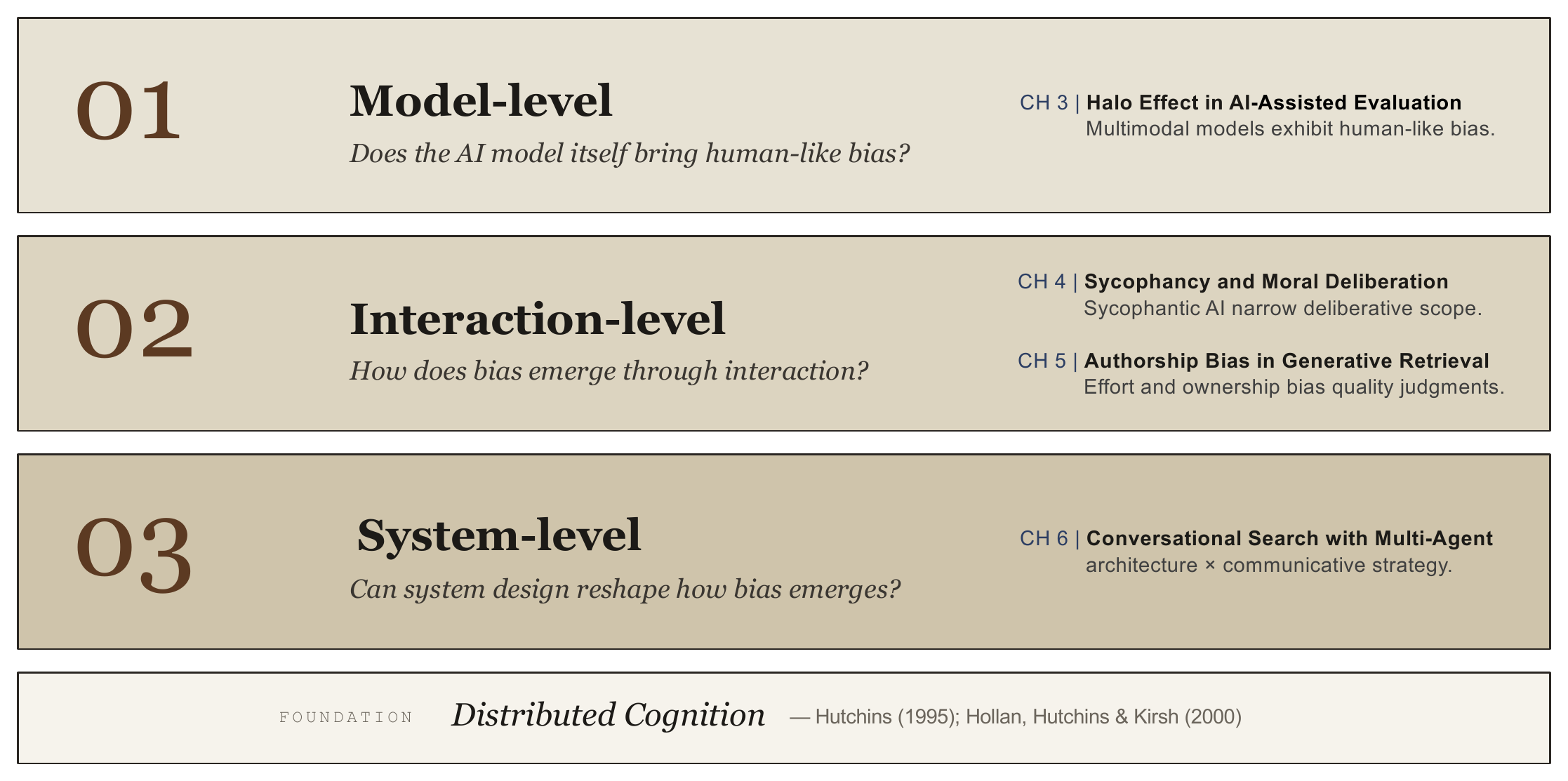
Drawing on distributed cognition, the dissertation organizes four empirical studies across three analytical layers. At the model-level, an assessment of multimodal language models in a hiring task shows that AI evaluators reproduce the halo effect, allowing job-irrelevant visual and contextual cues to systematically inflate judgments of applicant competence. At the interaction-level, two studies in distinct contexts examine how bias can be not only transferred through model outputs but also generated anew during interaction. The first study (N=31), a mixed-methods investigation of moral deliberation with AI, addresses a social context. Sycophantic AI responses raise users’ confidence in their own decisions while constraining open-minded thinking, producing a confidence-competence trade-off. The second study (N=28), a within-subjects investigation of generative information retrieval, addresses a co-productive context. The cognitive effort users invest in iterative interaction gives rise to psychological ownership, leading them to selectively overestimate the quality of the content they helped generate, even when conflicting information is present. At the system-level, a factorial study of conversational argument search (N=32) demonstrates that multi-agent architectures and agent-initiated questioning independently promote open-mindedness and critical thinking.
Taken together, these studies show that silent nudges in AI systems — low-salience interactional features that users perceive but whose judgment-shaping consequences they rarely recognize — produce salient shifts: measurable changes in evaluation, decision confidence, perceived quality, and engagement with diverse perspectives. The dissertation makes three contributions: (i) an interaction-based conceptual framework that locates bias in collaborative intelligence at the system level, grounded in distributed cognition; (ii) empirical evidence that bias in human-AI interaction can be inherent in models, generated through interaction, and reshaped by system design; and (iii) design principles for cognitively responsible AI systems. The broader implication is that the concept of helpfulness in AI alignment needs to be redefined. A helpful AI system is not one that minimizes friction or maximizes user satisfaction, but one that strengthens the user’s capacity to evaluate, deliberate, verify, and reflect.